

Apoorva Ajith
Saket Kumar
Chennai, 1 February 2025
The Indian government will aim for a fiscal deficit of 4.4% of Gross Domestic Product (GDP) in FY26–a target economists believe is difficult to achieve.
The government estimates the fiscal deficit to be 0.4 percentage points lower than the revised estimates of FY25. This is also the lowest deficit target in the last six years.
In the Union Budget for FY26, total expenditure is estimated at Rs 50.6 lakh crore against total receipts (excluding borrowing) of Rs 34.9 lakh crore in FY26.
“4.4% of fiscal deficit can be attained only through expenditure compression if revenues are not buoyant,” said Lekha Chakraborty, professor at the National Institute of Public Finance and Policy (NIPFP).
These expenditure cut may happen in schemes targeted at rural areas. An inability to meet the deficit can lead to a cut in government spending on rural development, said Dr Zico Dasgupta, an economist. “Typically for the last 5-10 years the burden has particularly fallen on rural expenditure”.
The Union Budget comes in the backdrop of economic uncertainties in Europe, a global economic slowdown, and tariff threats from the Trump administration. The government’s fiscal deficit target is the latest example of the Modi government’s efforts towards fiscal consolidation even as the economy grew at 5.4% in the second quarter of FY25, the slowest in the last seven quarters.
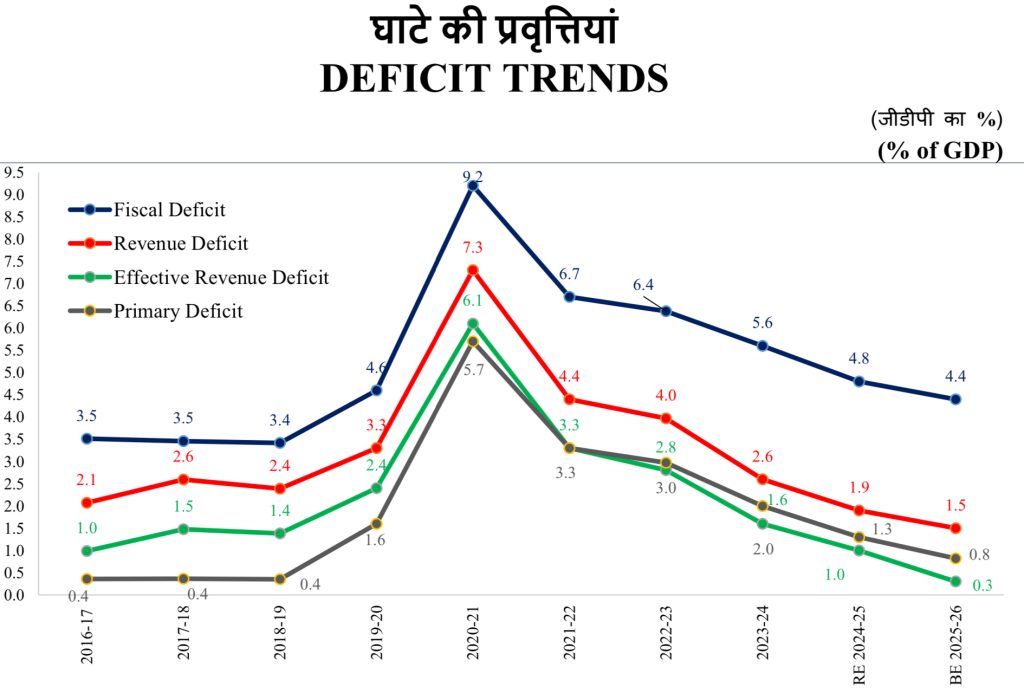
Source: Union Budget
Economists also expect difficulty in achieving the fiscal deficit target as global uncertainties may lead to a rise in the price of oil and gas. “If increasing value of imports is taken into account, then your figures for fiscal deficit go away,” said Dr Harilal, Chairman of Kerala’s Seventh State Finance Commission.
The Union government plans to finance the deficit by Rs 14.82 lakh crore of gross borrowings. The Finance Minister can decrease the size of the government by cutting revenue expenditure or maintain the desired expenditure by incurring deficits, said Chakraborty.